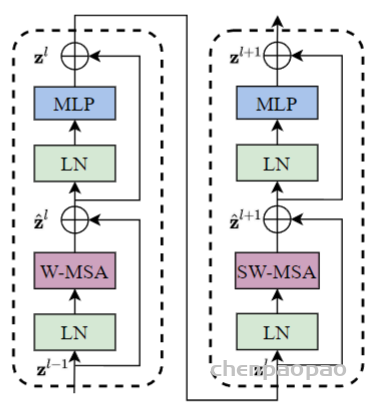
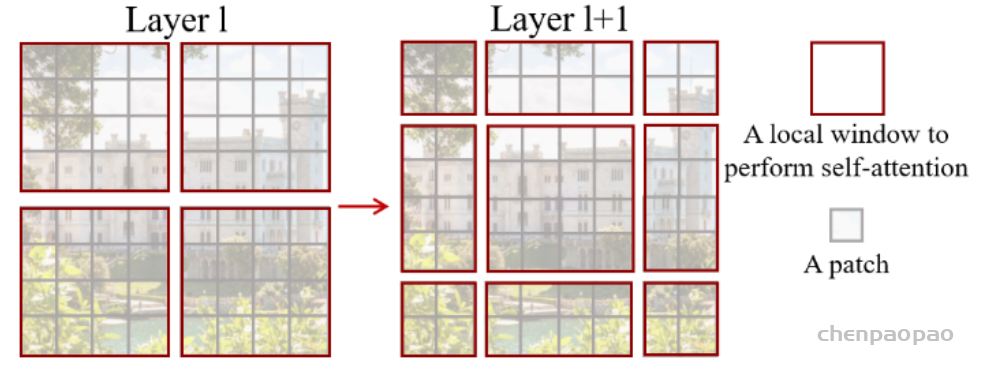
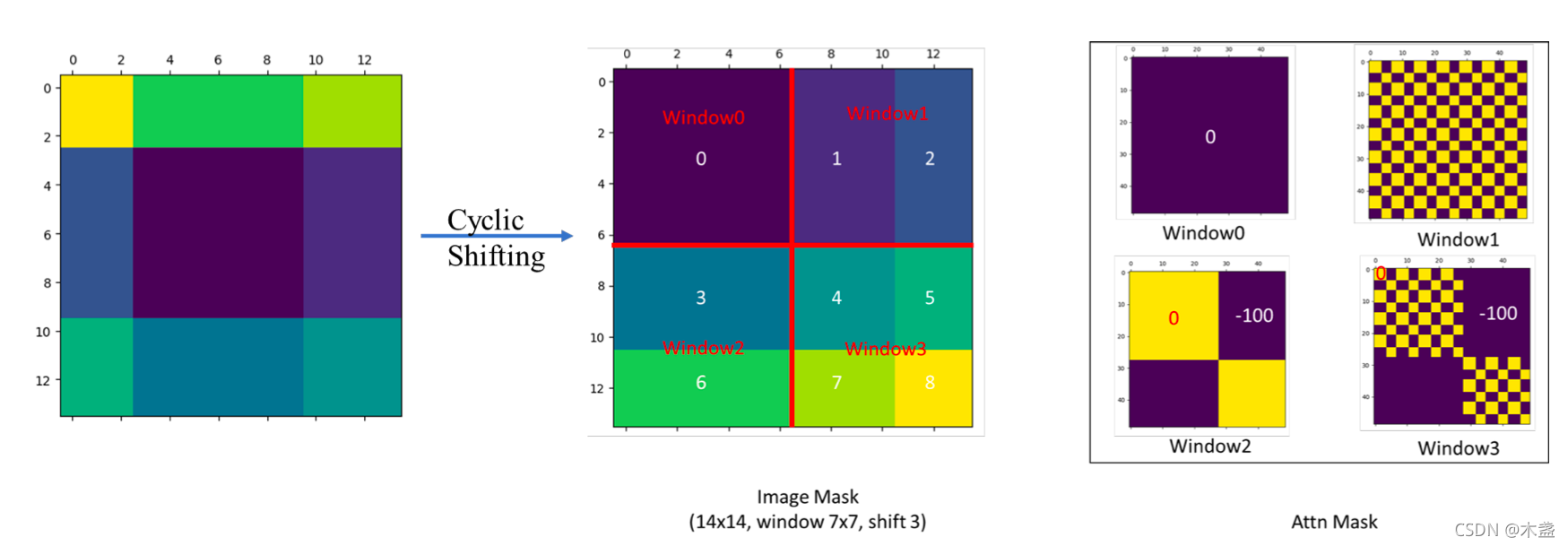
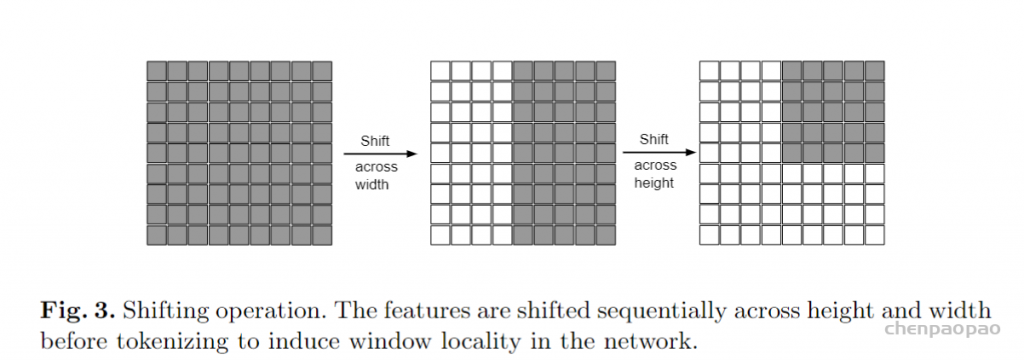
Roll the tensor input along the given dimension(s). Elements that are shifted beyond the last position are re-introduced at the first position. If dims is None, the tensor will be flattened before rolling and then restored to the original shape.Parameters
shifts (int or tuple of python:ints) – The number of places by which the elements of the tensor are shifted. If shifts is a tuple, dims must be a tuple of the same size, and each dimension will be rolled by the corresponding value
dims (int or tuple of python:ints) – Axis along which to roll
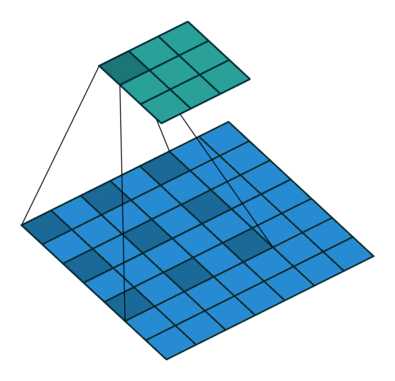
其中 ri 是 i 层的 dilation rate 而 Mi 是指在 i 层的最大dilation rate,那么假设总共有n层的话,默认 Mn=rn 。假设我们应用于 kernel 为 k x k 的话,我们的目标则是 M2≤k ,这样我们至少可以用 dilation rate 1 即 standard convolution 的方式来覆盖掉所有洞。
一个简单的例子: dilation rate [1, 2, 5] with 3 x 3 kernel (可行的方案)
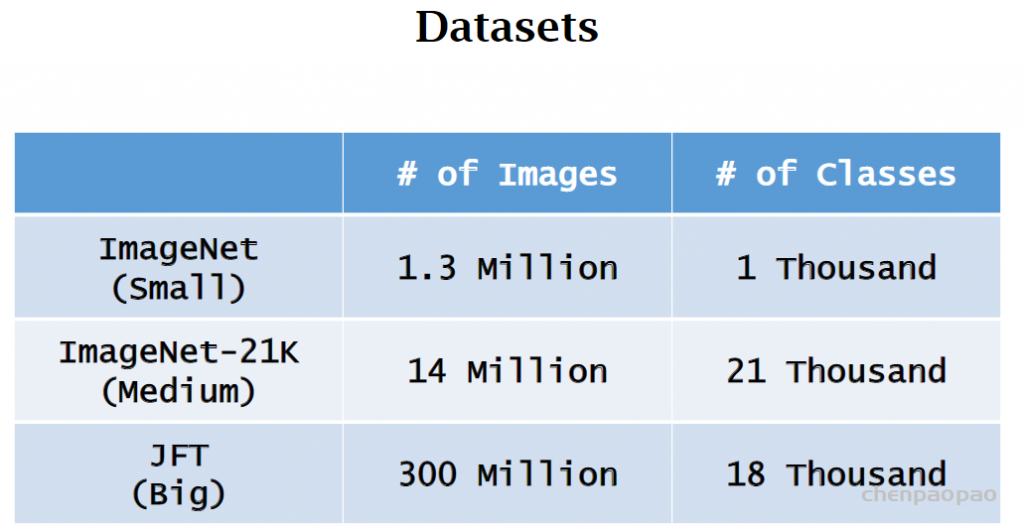
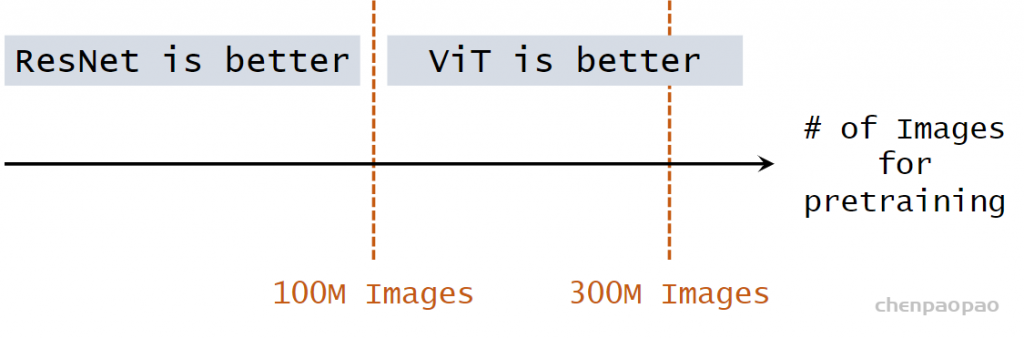
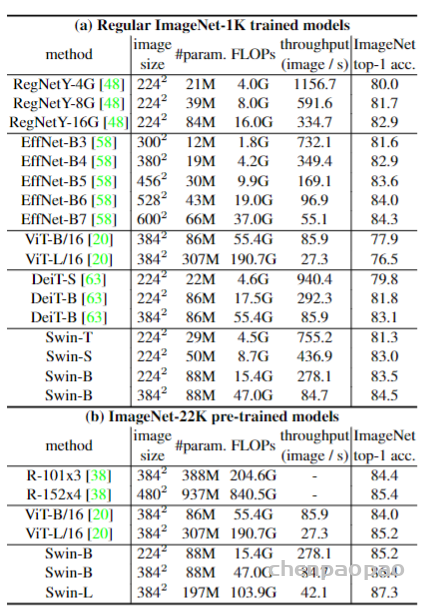
• Pretrain the model on Dataset A, fine-tune the model on Dataset B, and evaluate the model on Dataset B. • Pretrained on ImageNet (small), ViT is slightly worse than ResNet. • Pretrained on ImageNet-21K (medium), ViT is comparable to ResNet. • Pretrained on JFT (large), ViT is slightly better than ResNet.
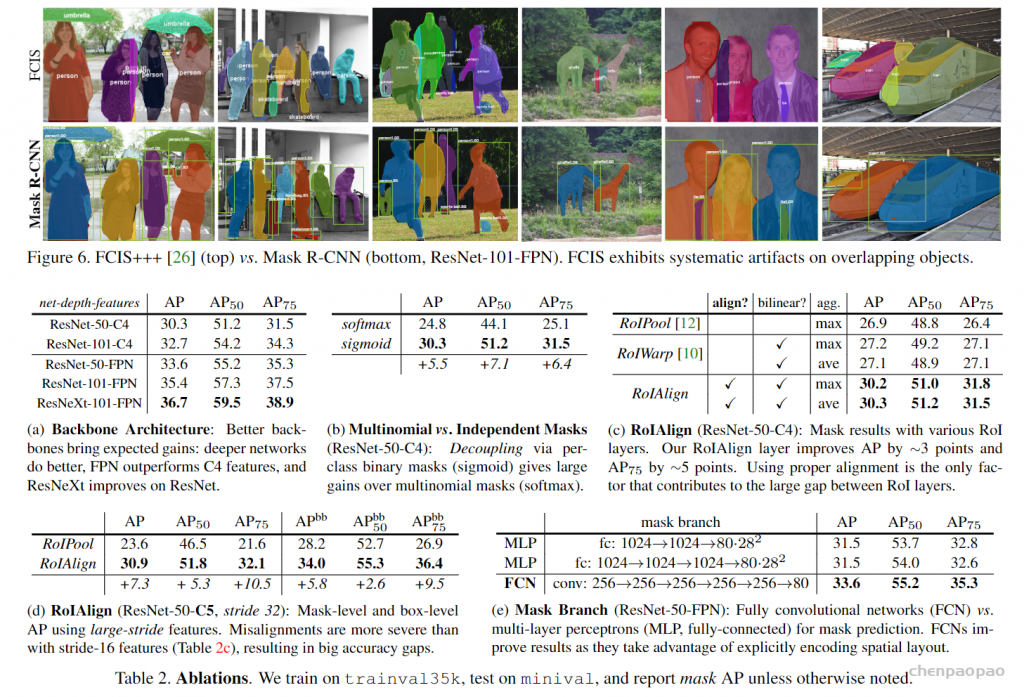
Multinomial vs. Independent Masks:(mask分支是否进行类别预测)从table 2b中可以看出,使用sigmoid(二分类)和使用softmax(多类别分类)的AP相差很大,证明了分离类别和mask的预测是很有必要的
Class-Specific vs. Class-Agnostic Masks:目前使用的mask rcnn都使用class-specific masks,即每个类别都会预测出一个mxm的mask,然后根据类别选取对应的类别的mask。但是使用Class-Agnostic Masks,即分割网络只输出一个mxm的mask,可以取得相似的成绩29.7vs30.3
RoIAlign:tabel 2c证明了RoIAlign的性能
Mask Branch:tabel 2e,FCN比MLP性能更好
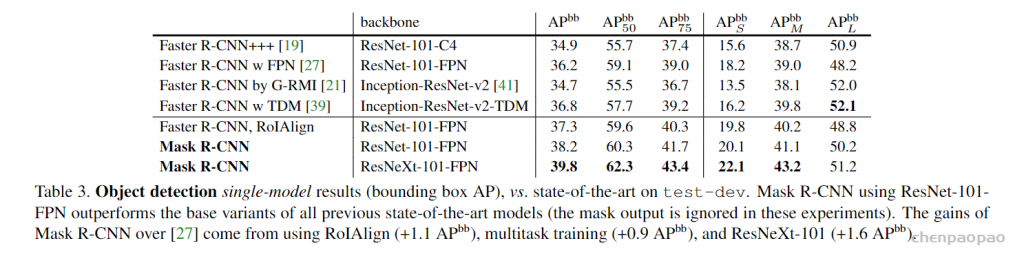
Bounding Box Detection Results
Mask RCNN精度高于Faster RCNN
Faster RCNN使用RoI Align的精度更高
Mask RCNN的分割任务得分与定位任务得分相近,说明Mask RCNN已经缩小了这部分差距。
Timing
Inference:195ms一张图片,显卡Nvidia Tesla M40。其实还有速度提升的空间,比如减少proposal的数量等。
Training:ResNet-50-FPN on COCO trainval35k takes 32 hours in our synchronized 8-GPU implementation (0.72s per 16-image mini-batch),and 44 hours with ResNet-101-FPN。
Part I: Brain development and atlases; DWI and tractography; functional brain networks; neuroimaging; heart and lung imaging; dermatology;

Part II: Computational (integrative) pathology; computational anatomy and physiology; ophthalmology; fetal imaging;

Part III: Breast imaging; colonoscopy; computer aided diagnosis;

Part IV: Microscopic image analysis; positron emission tomography; ultrasound imaging; video data analysis; image segmentation I;

Part V: Image segmentation II; integration of imaging with non-imaging biomarkers;

Part VI: Image registration; image reconstruction;

Part VII: Image-Guided interventions and surgery; outcome and disease prediction; surgical data science; surgical planning and simulation; machine learning – domain adaptation and generalization;

Part VIII: Machine learning – weakly-supervised learning; machine learning – model interpretation; machine learning – uncertainty; machine learning theory and methodologies.
其中关于分割有两个部分,Image segmentation I 在 Part IV, 而 Image segmentation II 在 Part V。